Why a Room Feels Easier to Use When Its Routes Stay Clear
Clear room routes make everyday movement less awkward. Observe where people walk, then make a small furniture adjustment that suits the room.
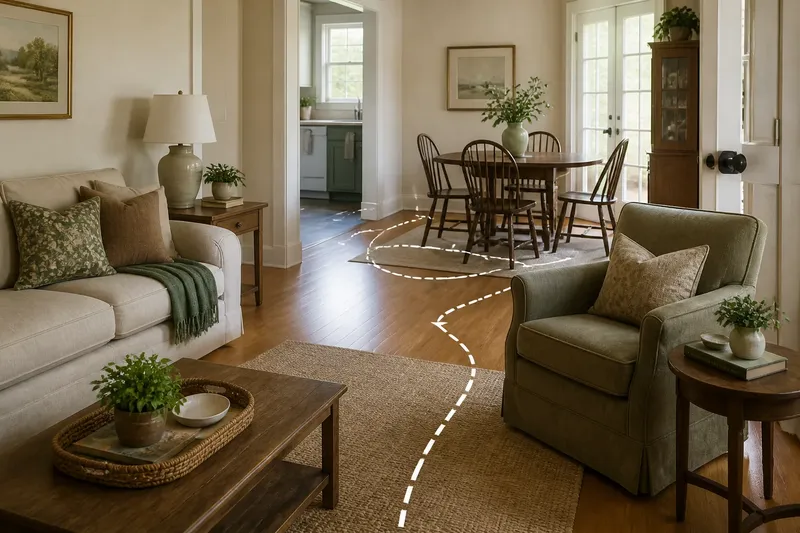
You carry a mug from the kitchen, turn sideways to pass the dining chair, then step around the corner of a rug before reaching the sofa. Clear room routes can make that ordinary trip feel less awkward, and watching where people naturally walk is a useful way to decide whether furniture needs to move.
A route is the path taken between useful places: a doorway and a chair, a bed and a wardrobe, or a dining table and the kitchen. It is not simply an empty strip of floor. A good route lets someone move without repeatedly turning, squeezing past furniture or shifting an object out of the way.
In a Southern home, a room may need to serve several purposes at once: greeting visitors, resting after work and making space for family to gather. Instead of rearranging everything to make the room look orderly from one viewpoint, observe how people use it across an ordinary week. Their paths can show where one small adjustment would make daily movement feel more natural.
Notice the routes before moving furniture
Choose a week when the room is being used normally. There is no need to stage activities or ask everyone to change their habits. Simply notice the repeated trips and the points where movement slows, bends or stops.
For a few days, keep a scrap of paper on a nearby shelf and make a brief note after a noticeable obstruction. Record the starting point, destination and what caused the pause. “Hall to armchair; side table catches my hip” is more useful than “the room feels cramped”, because it points to a particular route and object.
Notice who is moving, too. A child carrying toys, someone bringing in a plate, or a guest looking for a seat may use the room differently from the person who usually sits there. The aim is not to treat one person’s preferred path as the only correct arrangement; it is to find the routes that matter most and where they interfere with one another.
Keep the observation brief and ordinary. A few clear notes are more useful than a detailed map of every step.
Mark the places that cause repeated detours
After several days, look for a pattern. A single bump against a chair may be a passing inconvenience; repeatedly shifting the same chair to get to the table suggests that its position is obstructing a regular route. Mark the object and the pinch point, rather than assuming the whole room needs a new layout.
Pinch points often appear where two routes meet. A person leaving a doorway may cross someone reaching the sofa, or the path from a dining chair to the kitchen may run behind another chair that is often pulled out. Furniture can look well placed while occupied and still make movement difficult once a seat is in use.
Consider the full movement, not just the gap between furniture in its resting position. An open drawer, a pulled-out chair or a door swung into the room changes the available floor space. For a small layout decision, check the room as it is used: open the cupboard, sit down, and let someone pass if that is part of the everyday routine.
If the obstruction comes from a loose cushion, basket or footstool, the simplest change may be to give it a better home. A route can be clearer without moving the main furniture at all.
Try one small layout change at a time
Once a recurring obstruction is clear, choose the smallest change that could improve it. Moving one chair, shifting a side table or turning a small rug may be enough to remove a repeated detour. Changing one thing at a time makes it easier to tell whether the route has improved.
Say you notice that the path from a sitting-room doorway to the sofa bends around a small table, and that people regularly nudge its lamp while passing. Imagine moving the table beside the armchair, where it remains useful to someone seated but no longer sits in the walking line. The expected observable result is that people can reach the sofa without turning around the table, while the lamp is still within reach from the chair.
Before shifting a heavy piece, clear loose objects from it and ask for help rather than straining. Avoid dragging furniture across delicate flooring; use suitable furniture sliders if appropriate, or lift with assistance. For a light chair or table, a short trial move is often enough to judge whether the change helps.
Keep a simple record of the old and new positions, perhaps by noting where the chair legs sat against the floorboards. If the change creates a new obstruction, return the piece to its previous position and try a different small adjustment. A trial is useful even when it shows that the original arrangement works better.
Check the arrangement through a normal week
Leave the revised layout in place during ordinary activities rather than judging it only while the room is empty. Pay attention to the route that prompted the change, then notice whether it has affected another regular path, such as getting to a window or carrying a tray to the table.
Use these moments to check the room:
- At the start of the day: Notice whether reaching a window, wardrobe or chair requires moving another object.
- During a shared meal: Check whether occupied chairs leave a usable path behind them.
- When carrying something: Observe whether a mug, laundry basket or serving dish can pass without awkward twisting.
- When someone is seated: See whether another person can enter or leave without asking them to move.
- At the end of the week: Compare your notes with the original obstruction and decide whether the adjustment should stay.
These are observations, not rules that every room must satisfy in exactly the same way. A room used mainly by one person may need a different route from a family room shared by children and visitors. Choose the paths that support the routines that matter in your home.
Small layout questions have practical answers?
Should furniture be moved away from every walking path?
No. A table or chair can sit beside a route and still work well if people can pass comfortably. The useful question is whether its position repeatedly blocks movement or forces an avoidable detour.
What if two people need the same part of the room?
Observe when their routes cross and whether the overlap causes a pause. Sometimes shifting one chair creates a clearer approach; in other cases, the paths matter at different times and the current arrangement is adequate.
How can a small room feel less awkward without buying furniture?
Start by moving loose items and testing one existing piece in a different position. A basket that belongs under a console or a side table moved beside a chair may clear a route without adding anything to the room.
How long should a layout trial last?
Keep it in place long enough to include the room’s ordinary routines, including times when chairs are pulled out or visitors come through. If the original problem is rare, continue observing until that routine occurs rather than deciding from a quiet day alone.
Keep the useful change and leave the rest
At the end of the week, return to the first notes. If the same route now feels easier and the change has not made another regular task awkward, keep the new position. If not, restore the old arrangement or make a different single adjustment.
Clear room routes are not about making every floor area empty. They are about giving everyday movement enough room to happen without repeated sidesteps, while keeping useful furniture close to the people who need it.
For the next small layout decision, use the route itself as a guide: start where someone enters, follow the path to the place they use, and move only the object that interrupts it. That keeps a room’s arrangement connected to the life happening inside it.