A Winter Afternoon, Lit with the Lamps You Have
A winter afternoon lamps plan uses familiar fixtures to give reading, conversation and quiet their own gentle pools of light in one shared room.
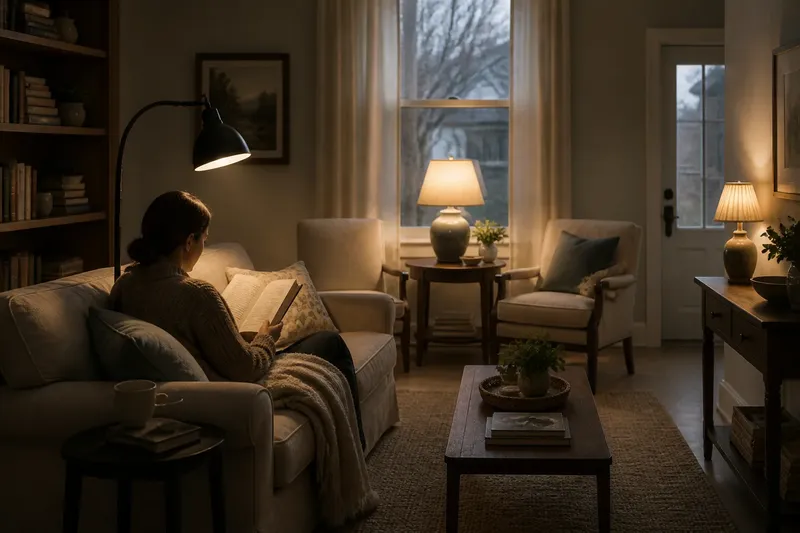
At half past three on a winter afternoon, the book on the sofa is readable, but the far end of the room has already gone dim. A winter afternoon lamps plan can use the fixtures already at home to make separate places for reading, conversation and quiet, without turning the whole room into one bright pool.
Imagine a modest sitting room in a Southern house: a sofa faces a low table, two chairs sit near a window, and a ceramic table lamp stands on a side table. There is also a floor lamp beside a bookcase and a small lamp on a console near the doorway. The aim is not to make every corner equally bright. It is to let each place feel suited to what happens there as daylight fades.
Begin with what each lamp can already reach
Before moving anything, notice where the light falls. A table lamp usually gives its strongest illumination close to its shade, while a floor lamp may spread light across a broader area or send it upwards. A small console lamp can make the entrance feel settled, though it may not help someone read on the sofa.
Switch on the lamps one at a time, then sit in the places people actually use. Check whether a book page is legible, whether faces remain visible across the chairs, and whether a bare bulb or bright shade falls into anyone’s line of sight. This is a quick way to distinguish a useful pool of light from a lamp that merely occupies a surface.
Keep a note of the lamp’s current position and shade before shifting it. That makes it easier to return the room to its usual arrangement if a move proves awkward.
Give the reading seat a clear pool of light
In the imagined room, the sofa is the natural reading place, but the ceramic lamp sits too far away to illuminate a book comfortably. The floor lamp beside the bookcase can move to the sofa’s outer edge, where its light reaches the reader without blocking the passage or shining directly towards the other chair.
Angle the shade so the light falls on the page rather than into the reader’s eyes. If the lamp has an adjustable head, a small change in direction may be enough; if it does not, shifting the whole lamp slightly can help. A side table provides a place for a book or mug, but it need not carry the lamp if the floor fixture is stable in its new position.
For a concrete, invented walk-through, say the floor lamp has a broad shade and the sofa sits near a wall outlet. Moving the lamp beside the sofa and turning its shade towards the reader should make the page easier to see, while leaving the window-side chair less brightly lit. If the cord then crosses a walking route, put the lamp back or choose another position rather than creating a trip hazard.
Let conversation remain comfortable across the room
The ceramic table lamp can serve the pair of chairs by the window. Placed between them, or on a nearby table that is already within reach, it gives the faces a gentle shared glow and makes the chairs read as a place for talking rather than as leftover seating.
Keep the shade low enough to soften the bulb, but not so low that it hides one person’s face from the other. The light need not match the reading pool in strength. A conversation often feels more relaxed when the speaker is visible without making the whole room feel as bright as a task area.
Where a table is narrow, the lamp may crowd a cup or elbow. In that case, retain the lamp on the side table and turn its shade towards the chairs, or use a stable surface already nearby. The useful arrangement is the one that supports both seeing and sitting naturally.
Keep a quieter corner deliberately dim
After the sofa and chairs have distinct purposes, the console lamp can remain near the doorway. It gives a low point of orientation for someone entering or crossing the room, while the bookcase corner can stay comparatively quiet. Not every dark area needs a lamp; contrast helps the lit places feel separate.
In the invented room, a person sitting in the chair away from the window wants to listen to music rather than read. Leaving that chair outside the strongest pool makes it feel like a retreat, while the console lamp provides enough background light to keep the room from seeming abruptly divided. The result is a sequence of small places, not a row of equally lit fixtures.
Try the arrangement at the time of day it is meant to serve. Winter daylight changes quickly, and a position that works at dusk may feel unnecessary earlier in the afternoon.
How should the arrangement change as daylight fades?
Should every lamp be switched on at once?
Not necessarily. Start with the lamp serving the activity in progress, then add another if a face, page or route is hard to see. This keeps the room’s different uses legible instead of flattening them into uniform brightness.
What if a lamp makes glare on a screen?
Shift the lamp sideways or turn its shade so the bright surface is not reflected in the screen. If the glare remains, a different lamp position is more useful than compensating by making the screen brighter.
Can a shaded lamp still help a room feel brighter?
Yes, if its shade directs light onto a pale wall or ceiling rather than trapping it beneath the shade. The effect depends on the fixture and the room’s surfaces, so judge it from the seat where the light is needed.
When is a lamp in the wrong place?
It is misplaced if it obstructs a route, feels unstable, shines into someone’s eyes or fails to support the activity nearby. A small relocation can be more helpful than adding another fixture.
Make the room easy to reset
The arrangement should still work when the room returns to its usual daytime use. Keep moved lamps close to existing surfaces and outlets, and avoid shifting heavy furniture simply to create a lighting effect. If a fixture is damaged, its cord is frayed, or its instructions specify restrictions, follow the manufacturer’s guidance and consult a qualified electrician where needed.
For the imagined room, the final setting is simple: the floor lamp serves the sofa’s book, the ceramic lamp draws the chairs together, and the console lamp marks the entrance. When the reader leaves, the floor lamp can be switched off while the other two remain on for conversation. The useful lesson in a winter afternoon lamps plan is that one room can support several moods through placement and direction, without demanding a new fixture for every activity.
Before the next grey afternoon, choose one seat and adjust only the lamp that serves it. Let the rest of the room stay as it is until you can tell what that single change has made.